Ever sit down to work with full intention, only to get distracted within minutes? Notifications, social media, random thoughts, and multitasking slowly reduce your focus. If you have been wondering what is pomodoro technique and whether it can genuinely improve productivity, you are in the right place.
In India’s evolving work culture, engagement levels are declining. A 2025 ADP Research report revealed that only 19% of Indian employees reported being fully engaged at work. Lower engagement directly affects productivity, motivation, and performance. This is exactly where structured systems like the Pomodoro Technique become powerful tools for focus management and consistent output. (Source: ADP India Workforce Engagement Report 2025)
“Productivity is not about working longer hours, it is about working smarter with focused intention.”
Let’s understand it clearly and practically.
What Is the Pomodoro Technique? A Simple Explanation
If you are asking what is pomodoro technique in simple words, here is the answer.
The Pomodoro Technique is a time management method that divides your work into structured work intervals, usually a 25-minute focus session followed by a short break. This creates a healthy work-rest cycle that improves attention and prevents burnout. By combining it with proven growth hacking frameworks for startups, founders and professionals can prioritize high-impact tasks while maintaining consistent productivity.The technique was created by Francesco Cirillo in the 1980s. He used a tomato-shaped timer, which inspired the name Pomodoro.
At its core, it is an anti-procrastination method designed to help you:
Work in focused bursts
Reduce distractions
Build consistent productivity habits
Avoid mental exhaustion
It is simple, but its impact can be significant.
How Does the Pomodoro Technique Work Step by Step?
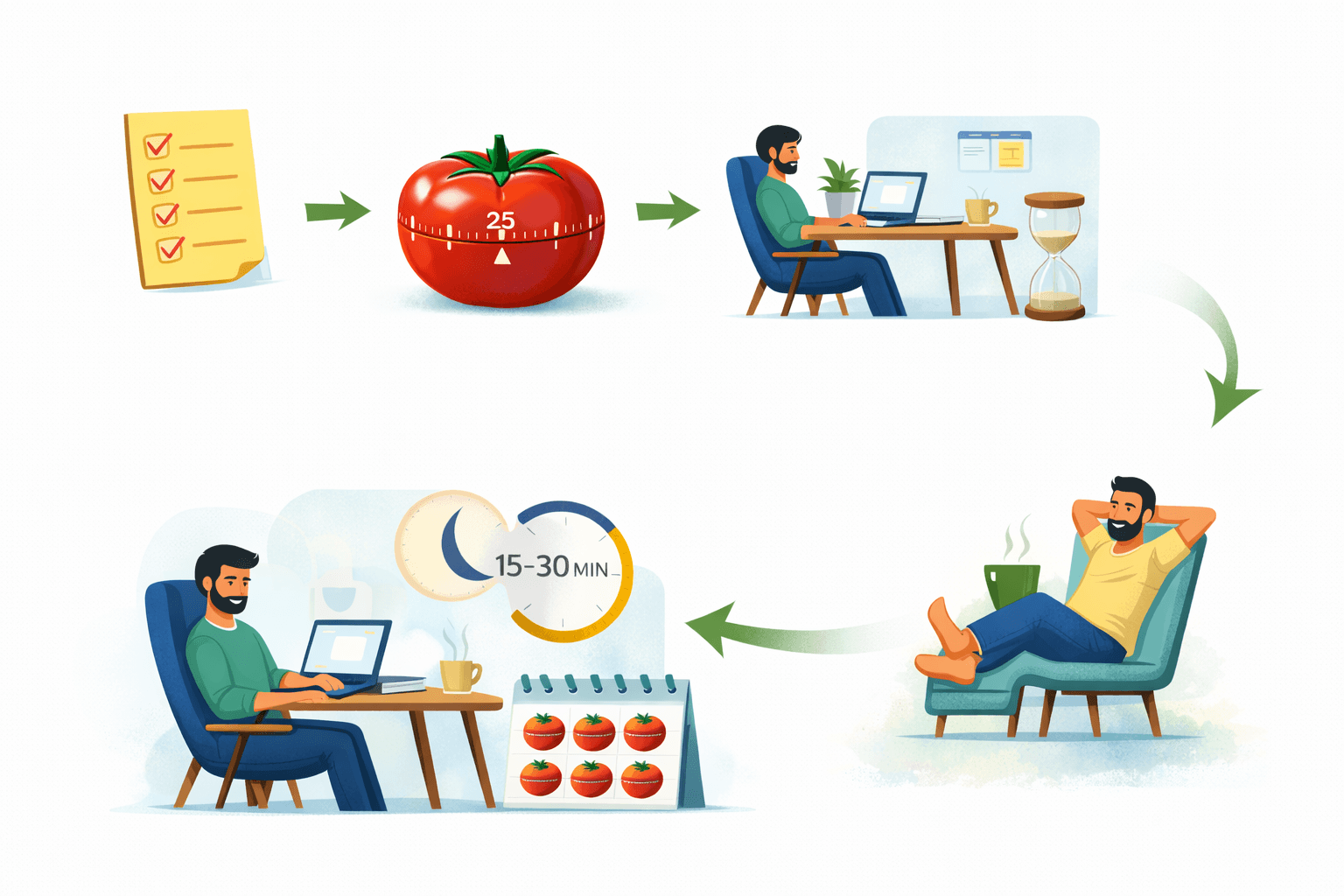
To fully understand what is pomodoro technique, you need to see how it works in practice.
Here is the step-by-step process:
Select one task to work on.
Set a timer for 25 minutes.
Work without interruption during that work interval.
Take a 5-minute break.
After four sessions, take a longer break of 15 to 30 minutes.
This task batching technique trains your brain to focus on a single responsibility. It works exceptionally well for students, professionals, entrepreneurs, and even homemakers. Adopting effective startup team building techniques alongside task batching ensures teams coordinate efficiently and maintain high output without unnecessary distractions.
If you are trying to manage academic responsibilities better, learning how to manage time for study can complement this system effectively.
Why Is the Pomodoro Technique Effective for Focus and Productivity?
Once you understand what is pomodoro technique, the next question is why it works.
The effectiveness comes from psychological principles:
Short sessions reduce overwhelm
Clear time boundaries improve concentration
Breaks prevent fatigue
Measurable sessions create motivation
When you commit to just 25 minutes, starting feels easier. This reduces procrastination and strengthens focus management.
To strengthen attention span even further, combining Pomodoro with strategies that help you strengthen attention span can improve long-term results.
Is the Pomodoro Technique Scientifically Proven?
There is no single study titled what is pomodoro technique that validates it directly. However, the structure aligns with research on cognitive performance and can be complemented by learning structured financial habits through a personal finance management course online.
Studies show the brain performs better in shorter, intense focus sessions followed by recovery periods. This structured work-rest cycle improves retention and reduces mental burnout. Using cold emailing techniques that drive responses in parallel with focused work sessions helps teams generate consistent results while minimizing overwhelm.
That is why it is widely recommended as part of sustainable study productivity systems and efficient work interval scheduling methods, particularly for those pursuing skill-building paths like a creative writing course.
Pomodoro Technique vs Time Blocking: Which Is More Effective?

Both methods are popular productivity systems, but they serve different purposes.
Pomodoro Technique:
Focuses on 25-minute work intervals
Includes structured breaks
Prioritizes attention control
Time Blocking:
Divides your entire day into task-specific blocks
Focuses on calendar organization
Helps manage multiple responsibilities
If distraction is your biggest problem, Pomodoro works better. If planning and scheduling are your weaknesses, time blocking may be more effective. Incorporating using cold email tools to increase B2B sales within structured planning ensures outreach efforts remain systematic and measurable.
For a broader understanding of different systems, you can explore a complete time management guide that explains various approaches.
How Does the Pomodoro Technique Improve Daily Productivity?
People who truly understand what is pomodoro technique notice improvements quickly.
It improves productivity by:
Increasing output per hour
Reducing task switching
Enhancing clarity
Building consistency
It also helps you stay productive under pressure because it shifts your focus to small manageable sessions instead of overwhelming projects.
Pairing it with a morning productivity routine can create strong daily momentum.
Watch How to Apply the Pomodoro Technique
This short video demonstrates how structured work intervals improve focus and shows how to apply the technique effectively in real life, especially if you’re planning to launch your online business and need better productivity systems.
Watching the method in action makes it easier to implement consistently.
Found this helpful? Share it with someone who struggles with focus.
Common Mistakes When Using the Pomodoro Technique
Many people fail not because the system does not work, but because they misuse it.
Common mistakes include:
Skipping breaks
Multitasking during sessions
Setting unrealistic task expectations
Ignoring progress tracking
The key is discipline and simplicity. If you often struggle with distractions, learning how to avoid productivity-killing behaviors can strengthen your system.
How Many Pomodoro Sessions Should You Complete in a Day?
There is no universal number.
On average:
Students complete 6 to 10 sessions
Professionals complete 8 to 12 sessions
The goal is not to maximize sessions but to maintain quality focus.
Integrating time and stress management strategies into your routine improves sustainability.
Can Professionals Use the Pomodoro Technique at Work?
Yes, and many high performers do.
It works well for:
Deep work tasks
Report preparation
Strategy planning
Coding and design
Skill development
If you want structured training, the time management mastery course provides frameworks that align perfectly with Pomodoro principles.
Does the Pomodoro Technique Help Prevent Burnout?
Yes, the built-in breaks protect mental energy and improve long-term consistency. The work-rest cycle reduces cognitive overload and supports emotional stability, which is especially useful for creators following a become a youtuber course to stay consistent with content production.
It can also be adapted for productivity skills for children to build disciplined focus habits early in life.
To deepen your productivity journey, explore Which Goal Setting Strategies Lead to Higher Performance? and How Can You Truly Achieve Work-Life Balance? to build long-term focus, clarity, and sustainable success. Understanding communication principles every leader should know ensures that your messaging and collaboration remain effective across teams and projects.
See how this technique has helped others improve their focus

This course gave me a different perspective on the value of time in our lives. This course has helped me understand how my day is shaped and it has helped me build the perfect working style and schedule.

Vishnu Nair (Working Professional)
If you are serious about "taking control of your time", this is "THE course" for you. Whether you are a student or a professional, this investment will "change your life". Don't think twice just enroll now and experience the difference!

Pranav .S. Tukkannavar (Student)
This served as a reminder that time is money. What struck me was that when we attach a value to our precious time it works like a charm. After this course, I have chosen to take charge of my time.

Allwyn Mendonca (Working Professional)
I have known pomodoro technique but most of the time I used to feel undermotivated to initiate it. I recently realized that I needed a mentor to guide me through this. thank you, Ankur sir, for assembling all these techniques at one place!

Jaya Ratnam (Student)
While it is true that I knew many concepts and activities regarding time management, this course actually connected many dots regarding time management. It broke a few myths which I had about time management.

Raj Shah (Working Professional)
This was a really great course. It provided me more than what I expected it would. Thanks to Ankur and his inspiring stance to help everyone be at their best self with regard to our productivity, time management and the other skills.

Krrish Garla (Student)
It was an awesome course. The best part of the course is the exercise which we have been given to perform. These exercises don't just teach us the valuable lessons of time but also remind us to be accountable for our own time and the things we do.

Bipasa Bose (Working Professional)
Overall, the course is the value for money. The exercises are well to bridge the gap between theory and application. It covers all the aspects of a student life. It is not the extension of the age old tricks, tips acting like a bandage.

Vinita Punjabi (Student)
Really an eye-opener. There are so many takeaways from the course - I have taken 20 pages of notes from the course! This course will really help me in achieving my career goals. This course has put these learnings in the most effective way possible.

Dr. Manthan Joshi (Working Professional)
Thank you, sir. Long study blocks without breaks left me overthinking and daydreaming. I even wondered if I had ADHD. Your 50-minute Pomodoro made me far more productive and reduced the overthinking!!

Sahil Suthar (Student)
This course was amazing. I learned a lot about time and its management. The calculation about time and the value of time that was taught us was totally mindblowing. This is an amazing course that can change the thought process about time.

Rishan Singh (Working Professional)
Awesome!! It change my life a lot , specially the module around procrastination where I learned how to block out distractions effectively. Thank you Ankur! I would highly recommend this course to everyone!

Nisha Rajput (Student)
This course not only helped me understand the right way to prioritise my tasks in day-to-day life but also helped me effectively manage my time. It helped me understand why I procrastinate and how can I eliminate that and stay productive.

Sumit Singh (Working Professional)
It has helped me a ton , the best course out there on time management. I have learned a lot on this course . Kudos to Mr.Ankur Warikoo and his entire team for providing such a beneficial and supreme content.

Mubeen Ahmed (Student)
The perspectives about time management that we tend to ignore in our daily lives were beautifully explained. This course was truly the answer to all of the questions people may have about time management.

Naveen Garg (Working Professional)
This course has given me a new perspective. I can now go about organising tasks without being unnecessarily emotional or guilty about them. This has helped me maintain high energy levels and get things done throughout the day.

Muhammed Al Ghazi (Working Professional)
I found the time management course incredibly beneficial. It provided practical strategies and tools that have already helped me organize my tasks more effectively. I can already see a positive impact on my daily routine.

Noorie Ayesha R (Working Professional)
Wow I am simply amazed with the entire course and I am happy that this was more than a paise wasool course. The best part? I can revisit it anytime.

Shiva Krishnan (Working Professional)
A must-have course for anyone seeking to master time management. The principles taught in this course are universally applicable and can lead to a significant improvement in your daily productivity and overall life.

Vinay K. Chodankar (Working Professional)
This course gave me a different perspective on the value of time in our lives. This course has helped me understand how my day is shaped and it has helped me build the perfect working style and schedule.
Vishnu Nair (Working Professional)
If you are serious about "taking control of your time", this is "THE course" for you. Whether you are a student or a professional, this investment will "change your life". Don't think twice just enroll now and experience the difference!
Pranav .S. Tukkannavar (Student)
This served as a reminder that time is money. What struck me was that when we attach a value to our precious time it works like a charm. After this course, I have chosen to take charge of my time.
Allwyn Mendonca (Working Professional)
I have known pomodoro technique but most of the time I used to feel undermotivated to initiate it. I recently realized that I needed a mentor to guide me through this. thank you, Ankur sir, for assembling all these techniques at one place!
Jaya Ratnam (Student)
While it is true that I knew many concepts and activities regarding time management, this course actually connected many dots regarding time management. It broke a few myths which I had about time management.
Raj Shah (Working Professional)
This was a really great course. It provided me more than what I expected it would. Thanks to Ankur and his inspiring stance to help everyone be at their best self with regard to our productivity, time management and the other skills.
Krrish Garla (Student)
It was an awesome course. The best part of the course is the exercise which we have been given to perform. These exercises don't just teach us the valuable lessons of time but also remind us to be accountable for our own time and the things we do.
Bipasa Bose (Working Professional)
Overall, the course is the value for money. The exercises are well to bridge the gap between theory and application. It covers all the aspects of a student life. It is not the extension of the age old tricks, tips acting like a bandage.
Vinita Punjabi (Student)
Really an eye-opener. There are so many takeaways from the course - I have taken 20 pages of notes from the course! This course will really help me in achieving my career goals. This course has put these learnings in the most effective way possible.
Dr. Manthan Joshi (Working Professional)
Thank you, sir. Long study blocks without breaks left me overthinking and daydreaming. I even wondered if I had ADHD. Your 50-minute Pomodoro made me far more productive and reduced the overthinking!!
Sahil Suthar (Student)
This course was amazing. I learned a lot about time and its management. The calculation about time and the value of time that was taught us was totally mindblowing. This is an amazing course that can change the thought process about time.
Rishan Singh (Working Professional)
Awesome!! It change my life a lot , specially the module around procrastination where I learned how to block out distractions effectively. Thank you Ankur! I would highly recommend this course to everyone!
Nisha Rajput (Student)
This course not only helped me understand the right way to prioritise my tasks in day-to-day life but also helped me effectively manage my time. It helped me understand why I procrastinate and how can I eliminate that and stay productive.
Sumit Singh (Working Professional)
It has helped me a ton , the best course out there on time management. I have learned a lot on this course . Kudos to Mr.Ankur Warikoo and his entire team for providing such a beneficial and supreme content.
Mubeen Ahmed (Student)
The perspectives about time management that we tend to ignore in our daily lives were beautifully explained. This course was truly the answer to all of the questions people may have about time management.
Naveen Garg (Working Professional)
This course has given me a new perspective. I can now go about organising tasks without being unnecessarily emotional or guilty about them. This has helped me maintain high energy levels and get things done throughout the day.
Muhammed Al Ghazi (Working Professional)
I found the time management course incredibly beneficial. It provided practical strategies and tools that have already helped me organize my tasks more effectively. I can already see a positive impact on my daily routine.
Noorie Ayesha R (Working Professional)
Wow I am simply amazed with the entire course and I am happy that this was more than a paise wasool course. The best part? I can revisit it anytime.
Shiva Krishnan (Working Professional)
A must-have course for anyone seeking to master time management. The principles taught in this course are universally applicable and can lead to a significant improvement in your daily productivity and overall life.
Vinay K. Chodankar (Working Professional)
This course gave me a different perspective on the value of time in our lives. This course has helped me understand how my day is shaped and it has helped me build the perfect working style and schedule.
Vishnu Nair (Working Professional)
If you are serious about "taking control of your time", this is "THE course" for you. Whether you are a student or a professional, this investment will "change your life". Don't think twice just enroll now and experience the difference!
Pranav .S. Tukkannavar (Student)
This served as a reminder that time is money. What struck me was that when we attach a value to our precious time it works like a charm. After this course, I have chosen to take charge of my time.
Allwyn Mendonca (Working Professional)
I have known pomodoro technique but most of the time I used to feel undermotivated to initiate it. I recently realized that I needed a mentor to guide me through this. thank you, Ankur sir, for assembling all these techniques at one place!
Jaya Ratnam (Student)
While it is true that I knew many concepts and activities regarding time management, this course actually connected many dots regarding time management. It broke a few myths which I had about time management.
Raj Shah (Working Professional)
This was a really great course. It provided me more than what I expected it would. Thanks to Ankur and his inspiring stance to help everyone be at their best self with regard to our productivity, time management and the other skills.
Krrish Garla (Student)
It was an awesome course. The best part of the course is the exercise which we have been given to perform. These exercises don't just teach us the valuable lessons of time but also remind us to be accountable for our own time and the things we do.
Bipasa Bose (Working Professional)
Overall, the course is the value for money. The exercises are well to bridge the gap between theory and application. It covers all the aspects of a student life. It is not the extension of the age old tricks, tips acting like a bandage.
Vinita Punjabi (Student)
Really an eye-opener. There are so many takeaways from the course - I have taken 20 pages of notes from the course! This course will really help me in achieving my career goals. This course has put these learnings in the most effective way possible.
Dr. Manthan Joshi (Working Professional)
Thank you, sir. Long study blocks without breaks left me overthinking and daydreaming. I even wondered if I had ADHD. Your 50-minute Pomodoro made me far more productive and reduced the overthinking!!
Sahil Suthar (Student)
This course was amazing. I learned a lot about time and its management. The calculation about time and the value of time that was taught us was totally mindblowing. This is an amazing course that can change the thought process about time.
Rishan Singh (Working Professional)
Awesome!! It change my life a lot , specially the module around procrastination where I learned how to block out distractions effectively. Thank you Ankur! I would highly recommend this course to everyone!
Nisha Rajput (Student)
This course not only helped me understand the right way to prioritise my tasks in day-to-day life but also helped me effectively manage my time. It helped me understand why I procrastinate and how can I eliminate that and stay productive.
Sumit Singh (Working Professional)
It has helped me a ton , the best course out there on time management. I have learned a lot on this course . Kudos to Mr.Ankur Warikoo and his entire team for providing such a beneficial and supreme content.
Mubeen Ahmed (Student)
The perspectives about time management that we tend to ignore in our daily lives were beautifully explained. This course was truly the answer to all of the questions people may have about time management.
Naveen Garg (Working Professional)
This course has given me a new perspective. I can now go about organising tasks without being unnecessarily emotional or guilty about them. This has helped me maintain high energy levels and get things done throughout the day.
Muhammed Al Ghazi (Working Professional)
I found the time management course incredibly beneficial. It provided practical strategies and tools that have already helped me organize my tasks more effectively. I can already see a positive impact on my daily routine.
Noorie Ayesha R (Working Professional)
Wow I am simply amazed with the entire course and I am happy that this was more than a paise wasool course. The best part? I can revisit it anytime.
Shiva Krishnan (Working Professional)
A must-have course for anyone seeking to master time management. The principles taught in this course are universally applicable and can lead to a significant improvement in your daily productivity and overall life.
Vinay K. Chodankar (Working Professional)
This course gave me a different perspective on the value of time in our lives. This course has helped me understand how my day is shaped and it has helped me build the perfect working style and schedule.
Vishnu Nair (Working Professional)
If you are serious about "taking control of your time", this is "THE course" for you. Whether you are a student or a professional, this investment will "change your life". Don't think twice just enroll now and experience the difference!
Pranav .S. Tukkannavar (Student)
This served as a reminder that time is money. What struck me was that when we attach a value to our precious time it works like a charm. After this course, I have chosen to take charge of my time.
Allwyn Mendonca (Working Professional)
I have known pomodoro technique but most of the time I used to feel undermotivated to initiate it. I recently realized that I needed a mentor to guide me through this. thank you, Ankur sir, for assembling all these techniques at one place!
Jaya Ratnam (Student)
While it is true that I knew many concepts and activities regarding time management, this course actually connected many dots regarding time management. It broke a few myths which I had about time management.
Raj Shah (Working Professional)
This was a really great course. It provided me more than what I expected it would. Thanks to Ankur and his inspiring stance to help everyone be at their best self with regard to our productivity, time management and the other skills.
Krrish Garla (Student)
It was an awesome course. The best part of the course is the exercise which we have been given to perform. These exercises don't just teach us the valuable lessons of time but also remind us to be accountable for our own time and the things we do.
Bipasa Bose (Working Professional)
Overall, the course is the value for money. The exercises are well to bridge the gap between theory and application. It covers all the aspects of a student life. It is not the extension of the age old tricks, tips acting like a bandage.
Vinita Punjabi (Student)
Really an eye-opener. There are so many takeaways from the course - I have taken 20 pages of notes from the course! This course will really help me in achieving my career goals. This course has put these learnings in the most effective way possible.
Dr. Manthan Joshi (Working Professional)
Thank you, sir. Long study blocks without breaks left me overthinking and daydreaming. I even wondered if I had ADHD. Your 50-minute Pomodoro made me far more productive and reduced the overthinking!!
Sahil Suthar (Student)
This course was amazing. I learned a lot about time and its management. The calculation about time and the value of time that was taught us was totally mindblowing. This is an amazing course that can change the thought process about time.
Rishan Singh (Working Professional)
Awesome!! It change my life a lot , specially the module around procrastination where I learned how to block out distractions effectively. Thank you Ankur! I would highly recommend this course to everyone!
Nisha Rajput (Student)
This course not only helped me understand the right way to prioritise my tasks in day-to-day life but also helped me effectively manage my time. It helped me understand why I procrastinate and how can I eliminate that and stay productive.
Sumit Singh (Working Professional)
It has helped me a ton , the best course out there on time management. I have learned a lot on this course . Kudos to Mr.Ankur Warikoo and his entire team for providing such a beneficial and supreme content.
Mubeen Ahmed (Student)
The perspectives about time management that we tend to ignore in our daily lives were beautifully explained. This course was truly the answer to all of the questions people may have about time management.
Naveen Garg (Working Professional)
This course has given me a new perspective. I can now go about organising tasks without being unnecessarily emotional or guilty about them. This has helped me maintain high energy levels and get things done throughout the day.
Muhammed Al Ghazi (Working Professional)
I found the time management course incredibly beneficial. It provided practical strategies and tools that have already helped me organize my tasks more effectively. I can already see a positive impact on my daily routine.
Noorie Ayesha R (Working Professional)
Wow I am simply amazed with the entire course and I am happy that this was more than a paise wasool course. The best part? I can revisit it anytime.
Shiva Krishnan (Working Professional)
A must-have course for anyone seeking to master time management. The principles taught in this course are universally applicable and can lead to a significant improvement in your daily productivity and overall life.
Vinay K. Chodankar (Working Professional)
If you want updates Please check our social Media
Conclusion
Now you clearly understand what is pomodoro technique and how it can transform your daily productivity.
It is a structured, simple, and powerful anti-procrastination method that improves focus management through work interval scheduling and planned breaks. In a distraction-heavy environment, this system restores clarity, discipline, and performance while aligning with effective goal setting strategies for high performance to achieve measurable outcomes.
If you want to improve your productivity, build stronger focus habits, and experience the true benefits of time management, start applying the Pomodoro Technique today.

About the Author
Ankur Warikoo is an entrepreneur and productivity educator, serving as the Instructor of the Time Management Course at Webveda, where he teaches practical systems to build focus, discipline, and sustainable productivity habits. His LinkedIn profile is provided below for those who wish to connect and learn more. He also emphasizes strategies to achieve a healthy work life balance to maintain well-being while scaling productivity.

FAQs
1. What is the Pomodoro Technique in simple terms?
It is a time management method that uses 25-minute focus sessions followed by short breaks.
2. Who invented the Pomodoro Technique?
Francesco Cirillo developed it in the late 1980s.
3. How does the Pomodoro Technique improve productivity?
It improves focus management, reduces distractions, and builds consistent work intervals.
4. Why is the Pomodoro Technique 25 minutes long?
Short focus sessions align with natural attention spans and prevent fatigue.
5. Can the Pomodoro Technique reduce procrastination?
Yes, because it lowers the resistance to starting tasks.
6. Is the Pomodoro Technique effective for studying?
Yes, it supports sustainable study productivity and structured revision.
7. How many Pomodoro sessions should I complete in a day?
Most people complete between 6 and 12 sessions depending on workload.
8. What are common mistakes when using the Pomodoro Technique?
Skipping breaks, multitasking, and not tracking sessions.
9. Can professionals use the Pomodoro Technique at work?
Yes, it works well for deep focus tasks and structured projects.
10. Does the Pomodoro Technique help prevent burnout?
Yes, the structured work-rest cycle supports energy recovery and long-term performance.
Ready To Start
Your Journey?
ENROLL NOW




Ever sit down to work with full intention, only to get distracted within minutes? Notifications, social media, random thoughts, and multitasking slowly reduce your focus. If you have been wondering what is pomodoro technique and whether it can genuinely improve productivity, you are in the right place.
In India’s evolving work culture, engagement levels are declining. A 2025 ADP Research report revealed that only 19% of Indian employees reported being fully engaged at work. Lower engagement directly affects productivity, motivation, and performance. This is exactly where structured systems like the Pomodoro Technique become powerful tools for focus management and consistent output. (Source: ADP India Workforce Engagement Report 2025)
“Productivity is not about working longer hours, it is about working smarter with focused intention.”
Let’s understand it clearly and practically.
What Is the Pomodoro Technique? A Simple Explanation
If you are asking what is pomodoro technique in simple words, here is the answer.
The Pomodoro Technique is a time management method that divides your work into structured work intervals, usually a 25-minute focus session followed by a short break. This creates a healthy work-rest cycle that improves attention and prevents burnout. By combining it with proven growth hacking frameworks for startups, founders and professionals can prioritize high-impact tasks while maintaining consistent productivity.The technique was created by Francesco Cirillo in the 1980s. He used a tomato-shaped timer, which inspired the name Pomodoro.
At its core, it is an anti-procrastination method designed to help you:
Work in focused bursts
Reduce distractions
Build consistent productivity habits
Avoid mental exhaustion
It is simple, but its impact can be significant.
How Does the Pomodoro Technique Work Step by Step?
To fully understand what is pomodoro technique, you need to see how it works in practice.
Here is the step-by-step process:
Select one task to work on.
Set a timer for 25 minutes.
Work without interruption during that work interval.
Take a 5-minute break.
After four sessions, take a longer break of 15 to 30 minutes.
This task batching technique trains your brain to focus on a single responsibility. It works exceptionally well for students, professionals, entrepreneurs, and even homemakers. Adopting effective startup team building techniques alongside task batching ensures teams coordinate efficiently and maintain high output without unnecessary distractions.
If you are trying to manage academic responsibilities better, learning how to manage time for study can complement this system effectively.
Why Is the Pomodoro Technique Effective for Focus and Productivity?
Once you understand what is pomodoro technique, the next question is why it works.
The effectiveness comes from psychological principles:
Short sessions reduce overwhelm
Clear time boundaries improve concentration
Breaks prevent fatigue
Measurable sessions create motivation
When you commit to just 25 minutes, starting feels easier. This reduces procrastination and strengthens focus management.
To strengthen attention span even further, combining Pomodoro with strategies that help you strengthen attention span can improve long-term results.
Is the Pomodoro Technique Scientifically Proven?
There is no single study titled what is pomodoro technique that validates it directly. However, the structure aligns with research on cognitive performance and can be complemented by learning structured financial habits through a personal finance management course online.
Studies show the brain performs better in shorter, intense focus sessions followed by recovery periods. This structured work-rest cycle improves retention and reduces mental burnout. Using cold emailing techniques that drive responses in parallel with focused work sessions helps teams generate consistent results while minimizing overwhelm.
That is why it is widely recommended as part of sustainable study productivity systems and efficient work interval scheduling methods, particularly for those pursuing skill-building paths like a creative writing course.
Pomodoro Technique vs Time Blocking: Which Is More Effective?
Both methods are popular productivity systems, but they serve different purposes.
Pomodoro Technique:
Focuses on 25-minute work intervals
Includes structured breaks
Prioritizes attention control
Time Blocking:
Divides your entire day into task-specific blocks
Focuses on calendar organization
Helps manage multiple responsibilities
If distraction is your biggest problem, Pomodoro works better. If planning and scheduling are your weaknesses, time blocking may be more effective. Incorporating using cold email tools to increase B2B sales within structured planning ensures outreach efforts remain systematic and measurable.
For a broader understanding of different systems, you can explore a complete time management guide that explains various approaches.
How Does the Pomodoro Technique Improve Daily Productivity?
People who truly understand what is pomodoro technique notice improvements quickly.
It improves productivity by:
Increasing output per hour
Reducing task switching
Enhancing clarity
Building consistency
It also helps you stay productive under pressure because it shifts your focus to small manageable sessions instead of overwhelming projects.
Pairing it with a morning productivity routine can create strong daily momentum.
Watch How to Apply the Pomodoro Technique
This short video demonstrates how structured work intervals improve focus and shows how to apply the technique effectively in real life, especially if you’re planning to launch your online business and need better productivity systems.
Watching the method in action makes it easier to implement consistently.
Found this helpful? Share it with someone who struggles with focus.
Common Mistakes When Using the Pomodoro Technique
Many people fail not because the system does not work, but because they misuse it.
Common mistakes include:
Skipping breaks
Multitasking during sessions
Setting unrealistic task expectations
Ignoring progress tracking
The key is discipline and simplicity. If you often struggle with distractions, learning how to avoid productivity-killing behaviors can strengthen your system.
How Many Pomodoro Sessions Should You Complete in a Day?
There is no universal number.
On average:
Students complete 6 to 10 sessions
Professionals complete 8 to 12 sessions
The goal is not to maximize sessions but to maintain quality focus.
Integrating time and stress management strategies into your routine improves sustainability.
Can Professionals Use the Pomodoro Technique at Work?
Yes, and many high performers do.
It works well for:
Deep work tasks
Report preparation
Strategy planning
Coding and design
Skill development
If you want structured training, the time management mastery course provides frameworks that align perfectly with Pomodoro principles.
Does the Pomodoro Technique Help Prevent Burnout?
Yes, the built-in breaks protect mental energy and improve long-term consistency. The work-rest cycle reduces cognitive overload and supports emotional stability, which is especially useful for creators following a become a youtuber course to stay consistent with content production.
It can also be adapted for productivity skills for children to build disciplined focus habits early in life.
To deepen your productivity journey, explore Which Goal Setting Strategies Lead to Higher Performance? and How Can You Truly Achieve Work-Life Balance? to build long-term focus, clarity, and sustainable success. Understanding communication principles every leader should know ensures that your messaging and collaboration remain effective across teams and projects.
See how this technique has helped others improve their focus
This course gave me a different perspective on the value of time in our lives. This course has helped me understand how my day is shaped and it has helped me build the perfect working style and schedule.
Vishnu Nair (Working Professional)
This served as a reminder that time is money. What struck me was that when we attach a value to our precious time it works like a charm. After this course, I have chosen to take charge of my time.
Allwyn Mendonca (Working Professional)
While it is true that I knew many concepts and activities regarding time management, this course actually connected many dots regarding time management. It broke a few myths which I had about time management.
Raj Shah (Working Professional)
It was an awesome course. The best part of the course is the exercise which we have been given to perform. These exercises don't just teach us the valuable lessons of time but also remind us to be accountable for our own time and the things we do.
Bipasa Bose (Working Professional)
Really an eye-opener. There are so many takeaways from the course - I have taken 20 pages of notes from the course! This course will really help me in achieving my career goals. This course has put these learnings in the most effective way possible.
Dr. Manthan Joshi (Working Professional)
This course was amazing. I learned a lot about time and its management. The calculation about time and the value of time that was taught us was totally mindblowing. This is an amazing course that can change the thought process about time.
Rishan Singh (Working Professional)
This course not only helped me understand the right way to prioritise my tasks in day-to-day life but also helped me effectively manage my time. It helped me understand why I procrastinate and how can I eliminate that and stay productive.
Sumit Singh (Working Professional)
The perspectives about time management that we tend to ignore in our daily lives were beautifully explained. This course was truly the answer to all of the questions people may have about time management.
Naveen Garg (Working Professional)
This course has given me a new perspective. I can now go about organising tasks without being unnecessarily emotional or guilty about them. This has helped me maintain high energy levels and get things done throughout the day.
Muhammed Al Ghazi (Working Professional)
I found the time management course incredibly beneficial. It provided practical strategies and tools that have already helped me organize my tasks more effectively. I can already see a positive impact on my daily routine.
Noorie Ayesha R (Working Professional)
Wow I am simply amazed with the entire course and I am happy that this was more than a paise wasool course. The best part? I can revisit it anytime.
Shiva Krishnan (Working Professional)
A must-have course for anyone seeking to master time management. The principles taught in this course are universally applicable and can lead to a significant improvement in your daily productivity and overall life.
Vinay K. Chodankar (Working Professional)
If you want updates Please check our social Media
Conclusion
Now you clearly understand what is pomodoro technique and how it can transform your daily productivity.
It is a structured, simple, and powerful anti-procrastination method that improves focus management through work interval scheduling and planned breaks. In a distraction-heavy environment, this system restores clarity, discipline, and performance while aligning with effective goal setting strategies for high performance to achieve measurable outcomes.
If you want to improve your productivity, build stronger focus habits, and experience the true benefits of time management, start applying the Pomodoro Technique today.
About the Author
Ankur Warikoo is an entrepreneur and productivity educator, serving as the Instructor of the Time Management Course at Webveda, where he teaches practical systems to build focus, discipline, and sustainable productivity habits. His LinkedIn profile is provided below for those who wish to connect and learn more. He also emphasizes strategies to achieve a healthy work life balance to maintain well-being while scaling productivity.
FAQs
1. What is the Pomodoro Technique in simple terms?
It is a time management method that uses 25-minute focus sessions followed by short breaks.
2. Who invented the Pomodoro Technique?
Francesco Cirillo developed it in the late 1980s.
3. How does the Pomodoro Technique improve productivity?
It improves focus management, reduces distractions, and builds consistent work intervals.
4. Why is the Pomodoro Technique 25 minutes long?
Short focus sessions align with natural attention spans and prevent fatigue.
5. Can the Pomodoro Technique reduce procrastination?
Yes, because it lowers the resistance to starting tasks.
6. Is the Pomodoro Technique effective for studying?
Yes, it supports sustainable study productivity and structured revision.
7. How many Pomodoro sessions should I complete in a day?
Most people complete between 6 and 12 sessions depending on workload.
8. What are common mistakes when using the Pomodoro Technique?
Skipping breaks, multitasking, and not tracking sessions.
9. Can professionals use the Pomodoro Technique at work?
Yes, it works well for deep focus tasks and structured projects.
10. Does the Pomodoro Technique help prevent burnout?
Yes, the structured work-rest cycle supports energy recovery and long-term performance.
Ready To Start
Your Journey?
ENROLL NOW
Ever sit down to work with full intention, only to get distracted within minutes? Notifications, social media, random thoughts, and multitasking slowly reduce your focus. If you have been wondering what is pomodoro technique and whether it can genuinely improve productivity, you are in the right place.
In India’s evolving work culture, engagement levels are declining. A 2025 ADP Research report revealed that only 19% of Indian employees reported being fully engaged at work. Lower engagement directly affects productivity, motivation, and performance. This is exactly where structured systems like the Pomodoro Technique become powerful tools for focus management and consistent output. (Source: ADP India Workforce Engagement Report 2025)
“Productivity is not about working longer hours, it is about working smarter with focused intention.”
Let’s understand it clearly and practically.
What Is the Pomodoro Technique? A Simple Explanation
If you are asking what is pomodoro technique in simple words, here is the answer.
The Pomodoro Technique is a time management method that divides your work into structured work intervals, usually a 25-minute focus session followed by a short break. This creates a healthy work-rest cycle that improves attention and prevents burnout. By combining it with proven growth hacking frameworks for startups, founders and professionals can prioritize high-impact tasks while maintaining consistent productivity.The technique was created by Francesco Cirillo in the 1980s. He used a tomato-shaped timer, which inspired the name Pomodoro.
At its core, it is an anti-procrastination method designed to help you:
Work in focused bursts
Reduce distractions
Build consistent productivity habits
Avoid mental exhaustion
It is simple, but its impact can be significant.
How Does the Pomodoro Technique Work Step by Step?
To fully understand what is pomodoro technique, you need to see how it works in practice.
Here is the step-by-step process:
Select one task to work on.
Set a timer for 25 minutes.
Work without interruption during that work interval.
Take a 5-minute break.
After four sessions, take a longer break of 15 to 30 minutes.
This task batching technique trains your brain to focus on a single responsibility. It works exceptionally well for students, professionals, entrepreneurs, and even homemakers. Adopting effective startup team building techniques alongside task batching ensures teams coordinate efficiently and maintain high output without unnecessary distractions.
If you are trying to manage academic responsibilities better, learning how to manage time for study can complement this system effectively.
Why Is the Pomodoro Technique Effective for Focus and Productivity?
Once you understand what is pomodoro technique, the next question is why it works.
The effectiveness comes from psychological principles:
Short sessions reduce overwhelm
Clear time boundaries improve concentration
Breaks prevent fatigue
Measurable sessions create motivation
When you commit to just 25 minutes, starting feels easier. This reduces procrastination and strengthens focus management.
To strengthen attention span even further, combining Pomodoro with strategies that help you strengthen attention span can improve long-term results.
Is the Pomodoro Technique Scientifically Proven?
There is no single study titled what is pomodoro technique that validates it directly. However, the structure aligns with research on cognitive performance and can be complemented by learning structured financial habits through a personal finance management course online.
Studies show the brain performs better in shorter, intense focus sessions followed by recovery periods. This structured work-rest cycle improves retention and reduces mental burnout. Using cold emailing techniques that drive responses in parallel with focused work sessions helps teams generate consistent results while minimizing overwhelm.
That is why it is widely recommended as part of sustainable study productivity systems and efficient work interval scheduling methods, particularly for those pursuing skill-building paths like a creative writing course.
Pomodoro Technique vs Time Blocking: Which Is More Effective?
Both methods are popular productivity systems, but they serve different purposes.
Pomodoro Technique:
Focuses on 25-minute work intervals
Includes structured breaks
Prioritizes attention control
Time Blocking:
Divides your entire day into task-specific blocks
Focuses on calendar organization
Helps manage multiple responsibilities
If distraction is your biggest problem, Pomodoro works better. If planning and scheduling are your weaknesses, time blocking may be more effective. Incorporating using cold email tools to increase B2B sales within structured planning ensures outreach efforts remain systematic and measurable.
For a broader understanding of different systems, you can explore a complete time management guide that explains various approaches.
How Does the Pomodoro Technique Improve Daily Productivity?
People who truly understand what is pomodoro technique notice improvements quickly.
It improves productivity by:
Increasing output per hour
Reducing task switching
Enhancing clarity
Building consistency
It also helps you stay productive under pressure because it shifts your focus to small manageable sessions instead of overwhelming projects.
Pairing it with a morning productivity routine can create strong daily momentum.
Watch How to Apply the Pomodoro Technique
This short video demonstrates how structured work intervals improve focus and shows how to apply the technique effectively in real life, especially if you’re planning to launch your online business and need better productivity systems.
Watching the method in action makes it easier to implement consistently.
Found this helpful? Share it with someone who struggles with focus.
Common Mistakes When Using the Pomodoro Technique
Many people fail not because the system does not work, but because they misuse it.
Common mistakes include:
Skipping breaks
Multitasking during sessions
Setting unrealistic task expectations
Ignoring progress tracking
The key is discipline and simplicity. If you often struggle with distractions, learning how to avoid productivity-killing behaviors can strengthen your system.
How Many Pomodoro Sessions Should You Complete in a Day?
There is no universal number.
On average:
Students complete 6 to 10 sessions
Professionals complete 8 to 12 sessions
The goal is not to maximize sessions but to maintain quality focus.
Integrating time and stress management strategies into your routine improves sustainability.
Can Professionals Use the Pomodoro Technique at Work?
Yes, and many high performers do.
It works well for:
Deep work tasks
Report preparation
Strategy planning
Coding and design
Skill development
If you want structured training, the time management mastery course provides frameworks that align perfectly with Pomodoro principles.
Does the Pomodoro Technique Help Prevent Burnout?
Yes, the built-in breaks protect mental energy and improve long-term consistency. The work-rest cycle reduces cognitive overload and supports emotional stability, which is especially useful for creators following a become a youtuber course to stay consistent with content production.
It can also be adapted for productivity skills for children to build disciplined focus habits early in life.
To deepen your productivity journey, explore Which Goal Setting Strategies Lead to Higher Performance? and How Can You Truly Achieve Work-Life Balance? to build long-term focus, clarity, and sustainable success. Understanding communication principles every leader should know ensures that your messaging and collaboration remain effective across teams and projects.
See how this technique has helped others improve their focus
This course gave me a different perspective on the value of time in our lives. This course has helped me understand how my day is shaped and it has helped me build the perfect working style and schedule.
Vishnu Nair (Working Professional)
If you are serious about "taking control of your time", this is "THE course" for you. Whether you are a student or a professional, this investment will "change your life". Don't think twice just enroll now and experience the difference!
Pranav .S. Tukkannavar (Student)
This served as a reminder that time is money. What struck me was that when we attach a value to our precious time it works like a charm. After this course, I have chosen to take charge of my time.
Allwyn Mendonca (Working Professional)
I have known pomodoro technique but most of the time I used to feel undermotivated to initiate it. I recently realized that I needed a mentor to guide me through this. thank you, Ankur sir, for assembling all these techniques at one place!
Jaya Ratnam (Student)
While it is true that I knew many concepts and activities regarding time management, this course actually connected many dots regarding time management. It broke a few myths which I had about time management.
Raj Shah (Working Professional)
Overall, the course is the value for money. The exercises are well to bridge the gap between theory and application. It covers all the aspects of a student life. It is not the extension of the age old tricks, tips acting like a bandage.
Vinita Punjabi (Student)
It was an awesome course. The best part of the course is the exercise which we have been given to perform. These exercises don't just teach us the valuable lessons of time but also remind us to be accountable for our own time and the things we do.
Bipasa Bose (Working Professional)
Thank you, sir. Long study blocks without breaks left me overthinking and daydreaming. I even wondered if I had ADHD. Your 50-minute Pomodoro made me far more productive and reduced the overthinking!!
Sahil Suthar (Student)
Really an eye-opener. There are so many takeaways from the course - I have taken 20 pages of notes from the course! This course will really help me in achieving my career goals. This course has put these learnings in the most effective way possible.
Dr. Manthan Joshi (Working Professional)
Awesome!! It change my life a lot , specially the module around procrastination where I learned how to block out distractions effectively. Thank you Ankur! I would highly recommend this course to everyone!
Nisha Rajput (Student)
This course was amazing. I learned a lot about time and its management. The calculation about time and the value of time that was taught us was totally mindblowing. This is an amazing course that can change the thought process about time.
Rishan Singh (Working Professional)
It has helped me a ton , the best course out there on time management. I have learned a lot on this course . Kudos to Mr.Ankur Warikoo and his entire team for providing such a beneficial and supreme content.
Mubeen Ahmed (Student)
This course not only helped me understand the right way to prioritise my tasks in day-to-day life but also helped me effectively manage my time. It helped me understand why I procrastinate and how can I eliminate that and stay productive.
Sumit Singh (Working Professional)
The perspectives about time management that we tend to ignore in our daily lives were beautifully explained. This course was truly the answer to all of the questions people may have about time management.
Naveen Garg (Working Professional)
This course has given me a new perspective. I can now go about organising tasks without being unnecessarily emotional or guilty about them. This has helped me maintain high energy levels and get things done throughout the day.
Muhammed Al Ghazi (Working Professional)
I found the time management course incredibly beneficial. It provided practical strategies and tools that have already helped me organize my tasks more effectively. I can already see a positive impact on my daily routine.
Noorie Ayesha R (Working Professional)
Wow I am simply amazed with the entire course and I am happy that this was more than a paise wasool course. The best part? I can revisit it anytime.
Shiva Krishnan (Working Professional)
A must-have course for anyone seeking to master time management. The principles taught in this course are universally applicable and can lead to a significant improvement in your daily productivity and overall life.
Vinay K. Chodankar (Working Professional)
This course gave me a different perspective on the value of time in our lives. This course has helped me understand how my day is shaped and it has helped me build the perfect working style and schedule.
Vishnu Nair (Working Professional)
If you are serious about "taking control of your time", this is "THE course" for you. Whether you are a student or a professional, this investment will "change your life". Don't think twice just enroll now and experience the difference!
Pranav .S. Tukkannavar (Student)
This served as a reminder that time is money. What struck me was that when we attach a value to our precious time it works like a charm. After this course, I have chosen to take charge of my time.
Allwyn Mendonca (Working Professional)
I have known pomodoro technique but most of the time I used to feel undermotivated to initiate it. I recently realized that I needed a mentor to guide me through this. thank you, Ankur sir, for assembling all these techniques at one place!
Jaya Ratnam (Student)
While it is true that I knew many concepts and activities regarding time management, this course actually connected many dots regarding time management. It broke a few myths which I had about time management.
Raj Shah (Working Professional)
Overall, the course is the value for money. The exercises are well to bridge the gap between theory and application. It covers all the aspects of a student life. It is not the extension of the age old tricks, tips acting like a bandage.
Vinita Punjabi (Student)
It was an awesome course. The best part of the course is the exercise which we have been given to perform. These exercises don't just teach us the valuable lessons of time but also remind us to be accountable for our own time and the things we do.
Bipasa Bose (Working Professional)
Thank you, sir. Long study blocks without breaks left me overthinking and daydreaming. I even wondered if I had ADHD. Your 50-minute Pomodoro made me far more productive and reduced the overthinking!!
Sahil Suthar (Student)
Really an eye-opener. There are so many takeaways from the course - I have taken 20 pages of notes from the course! This course will really help me in achieving my career goals. This course has put these learnings in the most effective way possible.
Dr. Manthan Joshi (Working Professional)
Awesome!! It change my life a lot , specially the module around procrastination where I learned how to block out distractions effectively. Thank you Ankur! I would highly recommend this course to everyone!
Nisha Rajput (Student)
This course was amazing. I learned a lot about time and its management. The calculation about time and the value of time that was taught us was totally mindblowing. This is an amazing course that can change the thought process about time.
Rishan Singh (Working Professional)
It has helped me a ton , the best course out there on time management. I have learned a lot on this course . Kudos to Mr.Ankur Warikoo and his entire team for providing such a beneficial and supreme content.
Mubeen Ahmed (Student)
This course not only helped me understand the right way to prioritise my tasks in day-to-day life but also helped me effectively manage my time. It helped me understand why I procrastinate and how can I eliminate that and stay productive.
Sumit Singh (Working Professional)
The perspectives about time management that we tend to ignore in our daily lives were beautifully explained. This course was truly the answer to all of the questions people may have about time management.
Naveen Garg (Working Professional)
This course has given me a new perspective. I can now go about organising tasks without being unnecessarily emotional or guilty about them. This has helped me maintain high energy levels and get things done throughout the day.
Muhammed Al Ghazi (Working Professional)
I found the time management course incredibly beneficial. It provided practical strategies and tools that have already helped me organize my tasks more effectively. I can already see a positive impact on my daily routine.
Noorie Ayesha R (Working Professional)
Wow I am simply amazed with the entire course and I am happy that this was more than a paise wasool course. The best part? I can revisit it anytime.
Shiva Krishnan (Working Professional)
A must-have course for anyone seeking to master time management. The principles taught in this course are universally applicable and can lead to a significant improvement in your daily productivity and overall life.
Vinay K. Chodankar (Working Professional)
This course gave me a different perspective on the value of time in our lives. This course has helped me understand how my day is shaped and it has helped me build the perfect working style and schedule.
Vishnu Nair (Working Professional)
If you are serious about "taking control of your time", this is "THE course" for you. Whether you are a student or a professional, this investment will "change your life". Don't think twice just enroll now and experience the difference!
Pranav .S. Tukkannavar (Student)
This served as a reminder that time is money. What struck me was that when we attach a value to our precious time it works like a charm. After this course, I have chosen to take charge of my time.
Allwyn Mendonca (Working Professional)
I have known pomodoro technique but most of the time I used to feel undermotivated to initiate it. I recently realized that I needed a mentor to guide me through this. thank you, Ankur sir, for assembling all these techniques at one place!
Jaya Ratnam (Student)
While it is true that I knew many concepts and activities regarding time management, this course actually connected many dots regarding time management. It broke a few myths which I had about time management.
Raj Shah (Working Professional)
Overall, the course is the value for money. The exercises are well to bridge the gap between theory and application. It covers all the aspects of a student life. It is not the extension of the age old tricks, tips acting like a bandage.
Vinita Punjabi (Student)
It was an awesome course. The best part of the course is the exercise which we have been given to perform. These exercises don't just teach us the valuable lessons of time but also remind us to be accountable for our own time and the things we do.
Bipasa Bose (Working Professional)
Thank you, sir. Long study blocks without breaks left me overthinking and daydreaming. I even wondered if I had ADHD. Your 50-minute Pomodoro made me far more productive and reduced the overthinking!!
Sahil Suthar (Student)
Really an eye-opener. There are so many takeaways from the course - I have taken 20 pages of notes from the course! This course will really help me in achieving my career goals. This course has put these learnings in the most effective way possible.
Dr. Manthan Joshi (Working Professional)
Awesome!! It change my life a lot , specially the module around procrastination where I learned how to block out distractions effectively. Thank you Ankur! I would highly recommend this course to everyone!
Nisha Rajput (Student)
This course was amazing. I learned a lot about time and its management. The calculation about time and the value of time that was taught us was totally mindblowing. This is an amazing course that can change the thought process about time.
Rishan Singh (Working Professional)
It has helped me a ton , the best course out there on time management. I have learned a lot on this course . Kudos to Mr.Ankur Warikoo and his entire team for providing such a beneficial and supreme content.
Mubeen Ahmed (Student)
This course not only helped me understand the right way to prioritise my tasks in day-to-day life but also helped me effectively manage my time. It helped me understand why I procrastinate and how can I eliminate that and stay productive.
Sumit Singh (Working Professional)
The perspectives about time management that we tend to ignore in our daily lives were beautifully explained. This course was truly the answer to all of the questions people may have about time management.
Naveen Garg (Working Professional)
This course has given me a new perspective. I can now go about organising tasks without being unnecessarily emotional or guilty about them. This has helped me maintain high energy levels and get things done throughout the day.
Muhammed Al Ghazi (Working Professional)
I found the time management course incredibly beneficial. It provided practical strategies and tools that have already helped me organize my tasks more effectively. I can already see a positive impact on my daily routine.
Noorie Ayesha R (Working Professional)
Wow I am simply amazed with the entire course and I am happy that this was more than a paise wasool course. The best part? I can revisit it anytime.
Shiva Krishnan (Working Professional)
A must-have course for anyone seeking to master time management. The principles taught in this course are universally applicable and can lead to a significant improvement in your daily productivity and overall life.
Vinay K. Chodankar (Working Professional)
This course gave me a different perspective on the value of time in our lives. This course has helped me understand how my day is shaped and it has helped me build the perfect working style and schedule.
Vishnu Nair (Working Professional)
If you are serious about "taking control of your time", this is "THE course" for you. Whether you are a student or a professional, this investment will "change your life". Don't think twice just enroll now and experience the difference!
Pranav .S. Tukkannavar (Student)
This served as a reminder that time is money. What struck me was that when we attach a value to our precious time it works like a charm. After this course, I have chosen to take charge of my time.
Allwyn Mendonca (Working Professional)
I have known pomodoro technique but most of the time I used to feel undermotivated to initiate it. I recently realized that I needed a mentor to guide me through this. thank you, Ankur sir, for assembling all these techniques at one place!
Jaya Ratnam (Student)
While it is true that I knew many concepts and activities regarding time management, this course actually connected many dots regarding time management. It broke a few myths which I had about time management.
Raj Shah (Working Professional)
Overall, the course is the value for money. The exercises are well to bridge the gap between theory and application. It covers all the aspects of a student life. It is not the extension of the age old tricks, tips acting like a bandage.
Vinita Punjabi (Student)
It was an awesome course. The best part of the course is the exercise which we have been given to perform. These exercises don't just teach us the valuable lessons of time but also remind us to be accountable for our own time and the things we do.
Bipasa Bose (Working Professional)
Thank you, sir. Long study blocks without breaks left me overthinking and daydreaming. I even wondered if I had ADHD. Your 50-minute Pomodoro made me far more productive and reduced the overthinking!!
Sahil Suthar (Student)
Really an eye-opener. There are so many takeaways from the course - I have taken 20 pages of notes from the course! This course will really help me in achieving my career goals. This course has put these learnings in the most effective way possible.
Dr. Manthan Joshi (Working Professional)
Awesome!! It change my life a lot , specially the module around procrastination where I learned how to block out distractions effectively. Thank you Ankur! I would highly recommend this course to everyone!
Nisha Rajput (Student)
This course was amazing. I learned a lot about time and its management. The calculation about time and the value of time that was taught us was totally mindblowing. This is an amazing course that can change the thought process about time.
Rishan Singh (Working Professional)
It has helped me a ton , the best course out there on time management. I have learned a lot on this course . Kudos to Mr.Ankur Warikoo and his entire team for providing such a beneficial and supreme content.
Mubeen Ahmed (Student)
This course not only helped me understand the right way to prioritise my tasks in day-to-day life but also helped me effectively manage my time. It helped me understand why I procrastinate and how can I eliminate that and stay productive.
Sumit Singh (Working Professional)
The perspectives about time management that we tend to ignore in our daily lives were beautifully explained. This course was truly the answer to all of the questions people may have about time management.
Naveen Garg (Working Professional)
This course has given me a new perspective. I can now go about organising tasks without being unnecessarily emotional or guilty about them. This has helped me maintain high energy levels and get things done throughout the day.
Muhammed Al Ghazi (Working Professional)
I found the time management course incredibly beneficial. It provided practical strategies and tools that have already helped me organize my tasks more effectively. I can already see a positive impact on my daily routine.
Noorie Ayesha R (Working Professional)
Wow I am simply amazed with the entire course and I am happy that this was more than a paise wasool course. The best part? I can revisit it anytime.
Shiva Krishnan (Working Professional)
A must-have course for anyone seeking to master time management. The principles taught in this course are universally applicable and can lead to a significant improvement in your daily productivity and overall life.
Vinay K. Chodankar (Working Professional)
If you want updates Please check
our social Media
Conclusion
Now you clearly understand what is pomodoro technique and how it can transform your daily productivity.
It is a structured, simple, and powerful anti-procrastination method that improves focus management through work interval scheduling and planned breaks. In a distraction-heavy environment, this system restores clarity, discipline, and performance while aligning with effective goal setting strategies for high performance to achieve measurable outcomes.
If you want to improve your productivity, build stronger focus habits, and experience the true benefits of time management, start applying the Pomodoro Technique today.
About the Author
Ankur Warikoo is an entrepreneur and productivity educator, serving as the Instructor of the Time Management Course at Webveda, where he teaches practical systems to build focus, discipline, and sustainable productivity habits. His LinkedIn profile is provided below for those who wish to connect and learn more. He also emphasizes strategies to achieve a healthy work life balance to maintain well-being while scaling productivity.
FAQs
1. What is the Pomodoro Technique in simple terms?
It is a time management method that uses 25-minute focus sessions followed by short breaks.
2. Who invented the Pomodoro Technique?
Francesco Cirillo developed it in the late 1980s.
3. How does the Pomodoro Technique improve productivity?
It improves focus management, reduces distractions, and builds consistent work intervals.
4. Why is the Pomodoro Technique 25 minutes long?
Short focus sessions align with natural attention spans and prevent fatigue.
5. Can the Pomodoro Technique reduce procrastination?
Yes, because it lowers the resistance to starting tasks.
6. Is the Pomodoro Technique effective for studying?
Yes, it supports sustainable study productivity and structured revision.
7. How many Pomodoro sessions should I complete in a day?
Most people complete between 6 and 12 sessions depending on workload.
8. What are common mistakes when using the Pomodoro Technique?
Skipping breaks, multitasking, and not tracking sessions.
9. Can professionals use the Pomodoro Technique at work?
Yes, it works well for deep focus tasks and structured projects.
10. Does the Pomodoro Technique help prevent burnout?
Yes, the structured work-rest cycle supports energy recovery and long-term performance.
Ready To Start
Your Journey?
ENROLL NOW
© Copyright 2025
© Copyright 2025
© Copyright 2025