Stage fright is one of the most common challenges people face when speaking in front of an audience. Whether it is a classroom presentation, a work meeting, or a public event, the fear of being judged often leads to nervousness, a shaky voice, and loss of confidence. Many people assume this fear will disappear on its own, but without the right approach, stage fright can become a major communication barrier that affects clarity and overall performance. Strengthening your speaking abilities through structured learning, such as an effective communication skills course, can play a key role in overcoming these challenges.
The good news is that stage fright is not a permanent condition. With proper preparation, emotional regulation, and consistent practice, anyone can learn to manage it effectively. This guide breaks down what causes stage fright, how it affects confidence, and why the importance of communication skills becomes even more critical when speaking under pressure, along with techniques that help you speak with calmness and control.
Click the video and take your first step towards clearer, more confident public speaking. It will help you to understand how to speak clearly, manage nervousness, and connect better with an audience, while also building essential skills through freelance mastery.
How Stage Fright Affects Your Communication and Confidence
Stage fright directly impacts how you express ideas and connect with your audience. When fear takes over, your stress response activates, making it harder to think clearly, articulate thoughts smoothly, and speak naturally. Many people struggle to improve their articulation skills under pressure, which further affects message clarity.
Ways stage fright affects communication
Reduced eye contact and weak audience engagement
Rushed or unclear speech delivery
Forgetting key points during presentations
Tense posture, closed gestures, and other nonverbal communication signals that reduce impact
Lower confidence during professional or academic speaking
Over time, repeated experiences with stage fright can create avoidance behaviour. People begin skipping opportunities that involve speaking, which limits personal growth and the development of active listening skills that are essential for strong two-way communication. Becoming aware of these impacts is the starting point for meaningful improvement.
Common Symptoms of Stage Fright You Should Know
Understanding the symptoms helps you manage them better. Stage fright affects both the mind and the body, often at the same time.
Physical symptoms
Rapid heartbeat
Dry mouth
Sweaty palms
Shaky voice
Tight shoulders or jaw
Mental and emotional symptoms
Fear of making mistakes
Overthinking audience reactions
Self doubt before speaking
Difficulty concentrating
These responses occur as part of the body’s normal reaction to stress. They are not signs of weakness. Learning how to calm the body and mind helps reduce their intensity, and developing overall confidence through a career development course online can further support this progress.
How to Prepare for a Speech or Presentation Effectively
Preparation is one of the strongest ways to reduce stage fright. When you feel prepared, your confidence increases automatically.
1. Structure your content clearly
Organize your speech with a clear opening, main points, and conclusion. Simple structure improves communication clarity and reduces anxiety.
2. Practice out loud, not just in your head
Speaking aloud helps train your voice and timing. It also helps you identify areas where you may hesitate. This habit is especially valuable when building strong communication skills for interviews, where clear delivery and confidence matter most.
3. Use visualization exercises
Visualize yourself speaking calmly and receiving positive reactions. Visualization exercises help rewire fear based thinking patterns.
4. Practice vocal warm-up techniques
Simple vocal warm-up routines improve voice control and reduce tension. This is especially helpful before presentations.
5. Rehearse in similar conditions
Practice standing up, using slides, or holding notes the same way you will during the actual presentation. This builds familiarity and comfort.
Consistent preparation reduces uncertainty, which is a major trigger of stage fright.
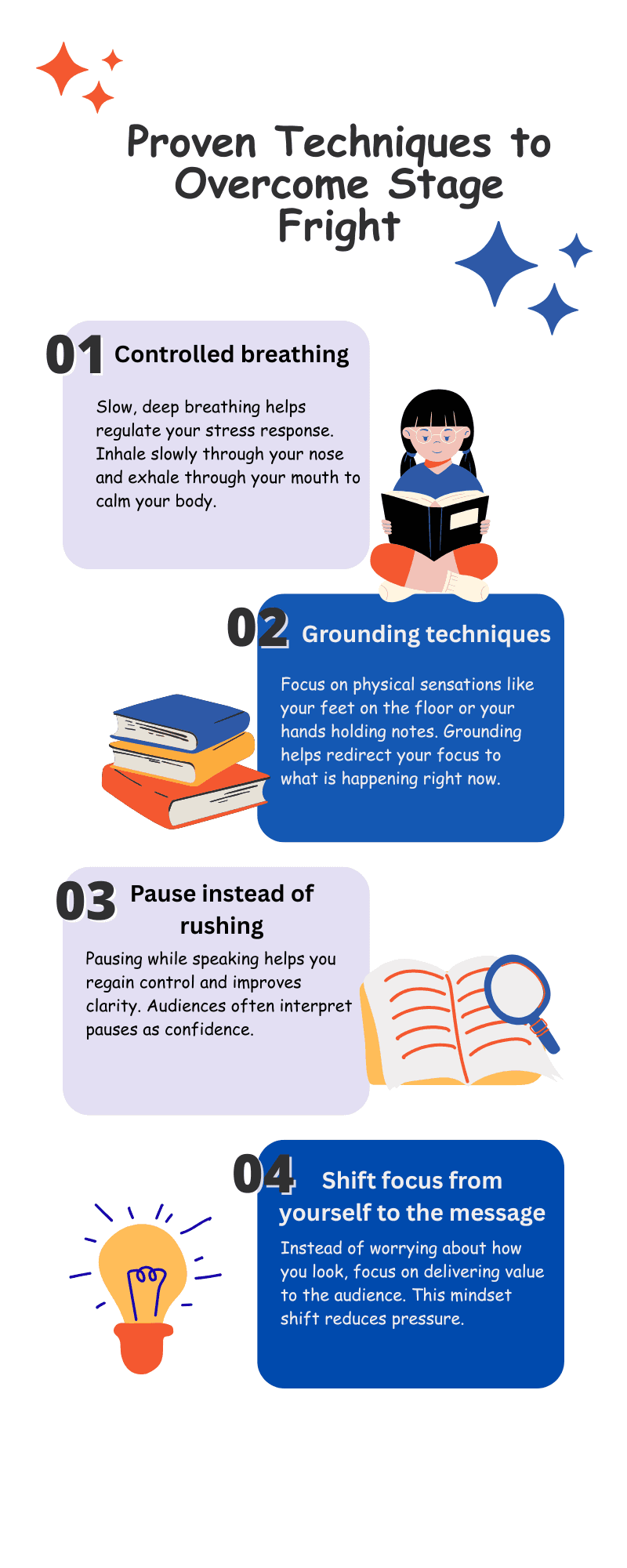

How a Communication Skills Course Can Help You Beat Stage Fright
Many people struggle to overcome stage fright because they lack structured guidance. A communication skills course provides practical training that targets both fear and performance, similar to the structured learning offered in a cold email course.
Such courses help you:
Improve public speaking habits
Learn emotional regulation techniques
Practice real speaking scenarios
Develop audience engagement skills
Build confidence step by step
If you want guided support, explore the communication improvement course offered by WebVeda. You can also Check our all courses to find programs focused on speaking confidence and performance.
Building Long Term Confidence for Stage Presentations
Overcoming stage fright is not about eliminating fear completely. It is about learning how to manage it effectively.
Habits that support long term improvement
Practice speaking regularly
Seek constructive feedback
Reflect on progress after each presentation
Use mindfulness practices to manage stress
Focus on continuous performance improvement
For additional tips, you may also find value in learning how to improve public speaking skills, which complements stage confidence training.
With time, fear becomes manageable and confidence grows naturally. The goal is steady improvement, not perfection, and maintaining consistency with techniques from time management courses can help reinforce that progress. Let’s see what our students have to say about the same.
After completing this course, I realised that language is not a barrier to communicating skills. Deep down, we are all human; we understand each other. With the process and exercises shared in this course, I hope to speak fluently with people around me in the future.

Stanzin Chuskit
The course is so much better than I had imagined it would be. I realized that there were some points that I was missing out on in my professional life and this course has made me understand how I can polish my skills and level myself up.

Shashwat Bhardwaj
This course is just what I was looking for. Thank you for giving me this wonderful opportunity to be part of this community. The course not only taught me command over communication skills but also helped me build self-confidence.

Shivani Bhatt
Extremely useful course. I found the tools I was looking for to make impactful conversations. It's now only a matter of religiously following & practicing it to excel in this art. I recommend others to take up this course.

Aasma Kakde
This course was very good for me because it provided me a systematic approach to conquer my fear of my communication. This course is simple and easy to relate to it. Thanks a lot to you for this priceless information.

Anurag Suhag
This course offers you to be an 'everyday learner' of life. It teaches you how to better your communication skills effectively and simplistically. It's the ultimate guide to moulding your personality one step at a time.

Elvira Lobo
This course is an invaluable resource for improving communication skills. It offers practical strategies and insightful advice, making it a must-have for anyone seeking to enhance their ability to connect and convey ideas effectively.

Sifat Singh Chawla
After completing this course, I realised that language is not a barrier to communicating skills. Deep down, we are all human; we understand each other. With the process and exercises shared in this course, I hope to speak fluently with people around me in the future.
Stanzin Chuskit
The course is so much better than I had imagined it would be. I realized that there were some points that I was missing out on in my professional life and this course has made me understand how I can polish my skills and level myself up.
Shashwat Bhardwaj
This course is just what I was looking for. Thank you for giving me this wonderful opportunity to be part of this community. The course not only taught me command over communication skills but also helped me build self-confidence.
Shivani Bhatt
Extremely useful course. I found the tools I was looking for to make impactful conversations. It's now only a matter of religiously following & practicing it to excel in this art. I recommend others to take up this course.
Aasma Kakde
This course was very good for me because it provided me a systematic approach to conquer my fear of my communication. This course is simple and easy to relate to it. Thanks a lot to you for this priceless information.
Anurag Suhag
This course offers you to be an 'everyday learner' of life. It teaches you how to better your communication skills effectively and simplistically. It's the ultimate guide to moulding your personality one step at a time.
Elvira Lobo
This course is an invaluable resource for improving communication skills. It offers practical strategies and insightful advice, making it a must-have for anyone seeking to enhance their ability to connect and convey ideas effectively.
Sifat Singh Chawla
After completing this course, I realised that language is not a barrier to communicating skills. Deep down, we are all human; we understand each other. With the process and exercises shared in this course, I hope to speak fluently with people around me in the future.
Stanzin Chuskit
The course is so much better than I had imagined it would be. I realized that there were some points that I was missing out on in my professional life and this course has made me understand how I can polish my skills and level myself up.
Shashwat Bhardwaj
This course is just what I was looking for. Thank you for giving me this wonderful opportunity to be part of this community. The course not only taught me command over communication skills but also helped me build self-confidence.
Shivani Bhatt
Extremely useful course. I found the tools I was looking for to make impactful conversations. It's now only a matter of religiously following & practicing it to excel in this art. I recommend others to take up this course.
Aasma Kakde
This course was very good for me because it provided me a systematic approach to conquer my fear of my communication. This course is simple and easy to relate to it. Thanks a lot to you for this priceless information.
Anurag Suhag
This course offers you to be an 'everyday learner' of life. It teaches you how to better your communication skills effectively and simplistically. It's the ultimate guide to moulding your personality one step at a time.
Elvira Lobo
This course is an invaluable resource for improving communication skills. It offers practical strategies and insightful advice, making it a must-have for anyone seeking to enhance their ability to connect and convey ideas effectively.
Sifat Singh Chawla
After completing this course, I realised that language is not a barrier to communicating skills. Deep down, we are all human; we understand each other. With the process and exercises shared in this course, I hope to speak fluently with people around me in the future.
Stanzin Chuskit
The course is so much better than I had imagined it would be. I realized that there were some points that I was missing out on in my professional life and this course has made me understand how I can polish my skills and level myself up.
Shashwat Bhardwaj
This course is just what I was looking for. Thank you for giving me this wonderful opportunity to be part of this community. The course not only taught me command over communication skills but also helped me build self-confidence.
Shivani Bhatt
Extremely useful course. I found the tools I was looking for to make impactful conversations. It's now only a matter of religiously following & practicing it to excel in this art. I recommend others to take up this course.
Aasma Kakde
This course was very good for me because it provided me a systematic approach to conquer my fear of my communication. This course is simple and easy to relate to it. Thanks a lot to you for this priceless information.
Anurag Suhag
This course offers you to be an 'everyday learner' of life. It teaches you how to better your communication skills effectively and simplistically. It's the ultimate guide to moulding your personality one step at a time.
Elvira Lobo
This course is an invaluable resource for improving communication skills. It offers practical strategies and insightful advice, making it a must-have for anyone seeking to enhance their ability to connect and convey ideas effectively.
Sifat Singh Chawla
Conclusion
Stage fright can feel overwhelming, but it does not have to control your communication or confidence. By understanding how it affects you, preparing effectively, and using proven techniques, you can manage fear and speak with clarity. Regular practice, emotional awareness, and structured learning play a major role in long term improvement. If you want to build stronger communication techniques and confidence, explore learning resources available on WebVeda, along with supportive tools and insights, including AI tools for future content marketing, that help professionals learn and perform with greater confidence. With the right approach, stage fright becomes a challenge you can handle, not a barrier you fear.
If you want updates Please check our social Media
FAQ
1. What is the main cause of stage fright?
Stage fright is mainly caused by fear of judgment, lack of preparation, and the body’s stress response during performance situations.
2. How can I instantly calm my nerves before speaking?
Slow breathing, grounding techniques, and brief vocal warm-up exercises help calm nerves quickly.
3. What are the best techniques to overcome stage fright?
Preparation, controlled breathing, visualization, regular practice, and mindset shifts are the most effective techniques.
4. Does practicing public speaking reduce stage fear?
Yes. Repeated practice builds familiarity and confidence, which gradually reduces fear.
5. How can beginners build confidence for stage presentations?
Start with small speaking opportunities, practice regularly, and focus on gradual improvement rather than perfection.
6. Can a communication skills course help overcome stage fright?
Yes. Structured courses provide guidance, feedback, and practical techniques that help manage fear and improve speaking confidence.
If you want updates Please check our social Media
FAQ
1. What is the main cause of stage fright?
Stage fright is mainly caused by fear of judgment, lack of preparation, and the body’s stress response during performance situations.
2. How can I instantly calm my nerves before speaking?
Slow breathing, grounding techniques, and brief vocal warm-up exercises help calm nerves quickly.
3. What are the best techniques to overcome stage fright?
Preparation, controlled breathing, visualization, regular practice, and mindset shifts are the most effective techniques.
4. Does practicing public speaking reduce stage fear?
Yes. Repeated practice builds familiarity and confidence, which gradually reduces fear.
5. How can beginners build confidence for stage presentations?
Start with small speaking opportunities, practice regularly, and focus on gradual improvement rather than perfection.
6. Can a communication skills course help overcome stage fright?
Yes. Structured courses provide guidance, feedback, and practical techniques that help manage fear and improve speaking confidence.
If you want updates Please check our social Media
Conclusion
Stage fright can feel overwhelming, but it does not have to control your communication or confidence. By understanding how it affects you, preparing effectively, and using proven techniques, you can manage fear and speak with clarity. Regular practice, emotional awareness, and structured learning play a major role in long term improvement. If you want to build stronger communication techniques and confidence, explore learning resources available on WebVeda, along with supportive tools and insights, including AI tools for future content marketing, that help professionals learn and perform with greater confidence. With the right approach, stage fright becomes a challenge you can handle, not a barrier you fear.
Ready To Start
Your Journey?
ENROLL NOW




Stage fright is one of the most common challenges people face when speaking in front of an audience. Whether it is a classroom presentation, a work meeting, or a public event, the fear of being judged often leads to nervousness, a shaky voice, and loss of confidence. Many people assume this fear will disappear on its own, but without the right approach, stage fright can become a major communication barrier that affects clarity and overall performance. Strengthening your speaking abilities through structured learning, such as an effective communication skills course, can play a key role in overcoming these challenges.
The good news is that stage fright is not a permanent condition. With proper preparation, emotional regulation, and consistent practice, anyone can learn to manage it effectively. This guide breaks down what causes stage fright, how it affects confidence, and why the importance of communication skills becomes even more critical when speaking under pressure, along with techniques that help you speak with calmness and control.
Click the video and take your first step towards clearer, more confident public speaking. It will help you to understand how to speak clearly, manage nervousness, and connect better with an audience, while also building essential skills through freelance mastery.
How Stage Fright Affects Your Communication and Confidence
Stage fright directly impacts how you express ideas and connect with your audience. When fear takes over, your stress response activates, making it harder to think clearly, articulate thoughts smoothly, and speak naturally. Many people struggle to improve their articulation skills under pressure, which further affects message clarity.
Ways stage fright affects communication
Reduced eye contact and weak audience engagement
Rushed or unclear speech delivery
Forgetting key points during presentations
Tense posture, closed gestures, and other nonverbal communication signals that reduce impact
Lower confidence during professional or academic speaking
Over time, repeated experiences with stage fright can create avoidance behaviour. People begin skipping opportunities that involve speaking, which limits personal growth and the development of active listening skills that are essential for strong two-way communication. Becoming aware of these impacts is the starting point for meaningful improvement.
Common Symptoms of Stage Fright You Should Know
Understanding the symptoms helps you manage them better. Stage fright affects both the mind and the body, often at the same time.
Physical symptoms
Rapid heartbeat
Dry mouth
Sweaty palms
Shaky voice
Tight shoulders or jaw
Mental and emotional symptoms
Fear of making mistakes
Overthinking audience reactions
Self doubt before speaking
Difficulty concentrating
These responses occur as part of the body’s normal reaction to stress. They are not signs of weakness. Learning how to calm the body and mind helps reduce their intensity, and developing overall confidence through a career development course online can further support this progress.
How to Prepare for a Speech or Presentation Effectively
Preparation is one of the strongest ways to reduce stage fright. When you feel prepared, your confidence increases automatically.
1. Structure your content clearly
Organize your speech with a clear opening, main points, and conclusion. Simple structure improves communication clarity and reduces anxiety.
2. Practice out loud, not just in your head
Speaking aloud helps train your voice and timing. It also helps you identify areas where you may hesitate. This habit is especially valuable when building strong communication skills for interviews, where clear delivery and confidence matter most.
3. Use visualization exercises
Visualize yourself speaking calmly and receiving positive reactions. Visualization exercises help rewire fear based thinking patterns.
4. Practice vocal warm-up techniques
Simple vocal warm-up routines improve voice control and reduce tension. This is especially helpful before presentations.
5. Rehearse in similar conditions
Practice standing up, using slides, or holding notes the same way you will during the actual presentation. This builds familiarity and comfort.
Consistent preparation reduces uncertainty, which is a major trigger of stage fright.
How a Communication Skills Course Can Help You Beat Stage Fright
Many people struggle to overcome stage fright because they lack structured guidance. A communication skills course provides practical training that targets both fear and performance, similar to the structured learning offered in a cold email course.
Such courses help you:
Improve public speaking habits
Learn emotional regulation techniques
Practice real speaking scenarios
Develop audience engagement skills
Build confidence step by step
If you want guided support, explore the communication improvement course offered by WebVeda. You can also Check our all courses to find programs focused on speaking confidence and performance.
Building Long Term Confidence for Stage Presentations
Overcoming stage fright is not about eliminating fear completely. It is about learning how to manage it effectively.
Habits that support long term improvement
Practice speaking regularly
Seek constructive feedback
Reflect on progress after each presentation
Use mindfulness practices to manage stress
Focus on continuous performance improvement
For additional tips, you may also find value in learning how to improve public speaking skills, which complements stage confidence training.
With time, fear becomes manageable and confidence grows naturally. The goal is steady improvement, not perfection, and maintaining consistency with techniques from time management courses can help reinforce that progress. Let’s see what our students have to say about the same.
After completing this course, I realised that language is not a barrier to communicating skills. Deep down, we are all human; we understand each other. With the process and exercises shared in this course, I hope to speak fluently with people around me in the future.
Stanzin Chuskit
The course is so much better than I had imagined it would be. I realized that there were some points that I was missing out on in my professional life and this course has made me understand how I can polish my skills and level myself up.
Shashwat Bhardwaj
This course is just what I was looking for. Thank you for giving me this wonderful opportunity to be part of this community. The course not only taught me command over communication skills but also helped me build self-confidence.
Shivani Bhatt
Extremely useful course. I found the tools I was looking for to make impactful conversations. It's now only a matter of religiously following & practicing it to excel in this art. I recommend others to take up this course.
Aasma Kakde
This course was very good for me because it provided me a systematic approach to conquer my fear of my communication. This course is simple and easy to relate to it. Thanks a lot to you for this priceless information.
Anurag Suhag
This course offers you to be an 'everyday learner' of life. It teaches you how to better your communication skills effectively and simplistically. It's the ultimate guide to moulding your personality one step at a time.
Elvira Lobo
Conclusion
Stage fright can feel overwhelming, but it does not have to control your communication or confidence. By understanding how it affects you, preparing effectively, and using proven techniques, you can manage fear and speak with clarity. Regular practice, emotional awareness, and structured learning play a major role in long term improvement. If you want to build stronger communication techniques and confidence, explore learning resources available on WebVeda, along with supportive tools and insights, including AI tools for future content marketing, that help professionals learn and perform with greater confidence. With the right approach, stage fright becomes a challenge you can handle, not a barrier you fear.
If you want updates Please check our social Media
FAQ
1. What is the main cause of stage fright?
Stage fright is mainly caused by fear of judgment, lack of preparation, and the body’s stress response during performance situations.
2. How can I instantly calm my nerves before speaking?
Slow breathing, grounding techniques, and brief vocal warm-up exercises help calm nerves quickly.
3. What are the best techniques to overcome stage fright?
Preparation, controlled breathing, visualization, regular practice, and mindset shifts are the most effective techniques.
4. Does practicing public speaking reduce stage fear?
Yes. Repeated practice builds familiarity and confidence, which gradually reduces fear.
5. How can beginners build confidence for stage presentations?
Start with small speaking opportunities, practice regularly, and focus on gradual improvement rather than perfection.
6. Can a communication skills course help overcome stage fright?
Yes. Structured courses provide guidance, feedback, and practical techniques that help manage fear and improve speaking confidence.
If you want updates Please check our social Media
FAQ
1. What is the main cause of stage fright?
Stage fright is mainly caused by fear of judgment, lack of preparation, and the body’s stress response during performance situations.
2. How can I instantly calm my nerves before speaking?
Slow breathing, grounding techniques, and brief vocal warm-up exercises help calm nerves quickly.
3. What are the best techniques to overcome stage fright?
Preparation, controlled breathing, visualization, regular practice, and mindset shifts are the most effective techniques.
4. Does practicing public speaking reduce stage fear?
Yes. Repeated practice builds familiarity and confidence, which gradually reduces fear.
5. How can beginners build confidence for stage presentations?
Start with small speaking opportunities, practice regularly, and focus on gradual improvement rather than perfection.
6. Can a communication skills course help overcome stage fright?
Yes. Structured courses provide guidance, feedback, and practical techniques that help manage fear and improve speaking confidence.
If you want updates Please check our social Media
Conclusion
Stage fright can feel overwhelming, but it does not have to control your communication or confidence. By understanding how it affects you, preparing effectively, and using proven techniques, you can manage fear and speak with clarity. Regular practice, emotional awareness, and structured learning play a major role in long term improvement. If you want to build stronger communication techniques and confidence, explore learning resources available on WebVeda, along with supportive tools and insights, including AI tools for future content marketing, that help professionals learn and perform with greater confidence. With the right approach, stage fright becomes a challenge you can handle, not a barrier you fear.
Ready To Start
Your Journey?
ENROLL NOW
Stage fright is one of the most common challenges people face when speaking in front of an audience. Whether it is a classroom presentation, a work meeting, or a public event, the fear of being judged often leads to nervousness, a shaky voice, and loss of confidence. Many people assume this fear will disappear on its own, but without the right approach, stage fright can become a major communication barrier that affects clarity and overall performance. Strengthening your speaking abilities through structured learning, such as an effective communication skills course, can play a key role in overcoming these challenges.
The good news is that stage fright is not a permanent condition. With proper preparation, emotional regulation, and consistent practice, anyone can learn to manage it effectively. This guide breaks down what causes stage fright, how it affects confidence, and why the importance of communication skills becomes even more critical when speaking under pressure, along with techniques that help you speak with calmness and control.
Click the video and take your first step towards clearer, more confident public speaking. It will help you to understand how to speak clearly, manage nervousness, and connect better with an audience, while also building essential skills through freelance mastery.
How Stage Fright Affects Your Communication and Confidence
Stage fright directly impacts how you express ideas and connect with your audience. When fear takes over, your stress response activates, making it harder to think clearly, articulate thoughts smoothly, and speak naturally. Many people struggle to improve their articulation skills under pressure, which further affects message clarity.
Ways stage fright affects communication
Reduced eye contact and weak audience engagement
Rushed or unclear speech delivery
Forgetting key points during presentations
Tense posture, closed gestures, and other nonverbal communication signals that reduce impact
Lower confidence during professional or academic speaking
Over time, repeated experiences with stage fright can create avoidance behaviour. People begin skipping opportunities that involve speaking, which limits personal growth and the development of active listening skills that are essential for strong two-way communication. Becoming aware of these impacts is the starting point for meaningful improvement.
Common Symptoms of Stage Fright You Should Know
Understanding the symptoms helps you manage them better. Stage fright affects both the mind and the body, often at the same time.
Physical symptoms
Rapid heartbeat
Dry mouth
Sweaty palms
Shaky voice
Tight shoulders or jaw
Mental and emotional symptoms
Fear of making mistakes
Overthinking audience reactions
Self doubt before speaking
Difficulty concentrating
These responses occur as part of the body’s normal reaction to stress. They are not signs of weakness. Learning how to calm the body and mind helps reduce their intensity, and developing overall confidence through a career development course online can further support this progress.
How to Prepare for a Speech or Presentation Effectively
Preparation is one of the strongest ways to reduce stage fright. When you feel prepared, your confidence increases automatically.
1. Structure your content clearly
Organize your speech with a clear opening, main points, and conclusion. Simple structure improves communication clarity and reduces anxiety.
2. Practice out loud, not just in your head
Speaking aloud helps train your voice and timing. It also helps you identify areas where you may hesitate. This habit is especially valuable when building strong communication skills for interviews, where clear delivery and confidence matter most.
3. Use visualization exercises
Visualize yourself speaking calmly and receiving positive reactions. Visualization exercises help rewire fear based thinking patterns.
4. Practice vocal warm-up techniques
Simple vocal warm-up routines improve voice control and reduce tension. This is especially helpful before presentations.
5. Rehearse in similar conditions
Practice standing up, using slides, or holding notes the same way you will during the actual presentation. This builds familiarity and comfort.
Consistent preparation reduces uncertainty, which is a major trigger of stage fright.
How a Communication Skills Course Can Help You Beat Stage Fright
Many people struggle to overcome stage fright because they lack structured guidance. A communication skills course provides practical training that targets both fear and performance, similar to the structured learning offered in a cold email course.
Such courses help you:
Improve public speaking habits
Learn emotional regulation techniques
Practice real speaking scenarios
Develop audience engagement skills
Build confidence step by step
If you want guided support, explore the communication improvement course offered by WebVeda. You can also Check our all courses to find programs focused on speaking confidence and performance.
Building Long Term Confidence for Stage Presentations
Overcoming stage fright is not about eliminating fear completely. It is about learning how to manage it effectively.
Habits that support long term improvement
Practice speaking regularly
Seek constructive feedback
Reflect on progress after each presentation
Use mindfulness practices to manage stress
Focus on continuous performance improvement
For additional tips, you may also find value in learning how to improve public speaking skills, which complements stage confidence training.
With time, fear becomes manageable and confidence grows naturally. The goal is steady improvement, not perfection, and maintaining consistency with techniques from time management courses can help reinforce that progress. Let’s see what our students have to say about the same.
After completing this course, I realised that language is not a barrier to communicating skills. Deep down, we are all human; we understand each other. With the process and exercises shared in this course, I hope to speak fluently with people around me in the future.
Stanzin Chuskit
The course is so much better than I had imagined it would be. I realized that there were some points that I was missing out on in my professional life and this course has made me understand how I can polish my skills and level myself up.
Shashwat Bhardwaj
This course is just what I was looking for. Thank you for giving me this wonderful opportunity to be part of this community. The course not only taught me command over communication skills but also helped me build self-confidence.
Shivani Bhatt
Extremely useful course. I found the tools I was looking for to make impactful conversations. It's now only a matter of religiously following & practicing it to excel in this art. I recommend others to take up this course.
Aasma Kakde
This course was very good for me because it provided me a systematic approach to conquer my fear of my communication. This course is simple and easy to relate to it. Thanks a lot to you for this priceless information.
Anurag Suhag
This course offers you to be an 'everyday learner' of life. It teaches you how to better your communication skills effectively and simplistically. It's the ultimate guide to moulding your personality one step at a time.
Elvira Lobo
This course is an invaluable resource for improving communication skills. It offers practical strategies and insightful advice, making it a must-have for anyone seeking to enhance their ability to connect and convey ideas effectively.
Sifat Singh Chawla
After completing this course, I realised that language is not a barrier to communicating skills. Deep down, we are all human; we understand each other. With the process and exercises shared in this course, I hope to speak fluently with people around me in the future.
Stanzin Chuskit
The course is so much better than I had imagined it would be. I realized that there were some points that I was missing out on in my professional life and this course has made me understand how I can polish my skills and level myself up.
Shashwat Bhardwaj
This course is just what I was looking for. Thank you for giving me this wonderful opportunity to be part of this community. The course not only taught me command over communication skills but also helped me build self-confidence.
Shivani Bhatt
Extremely useful course. I found the tools I was looking for to make impactful conversations. It's now only a matter of religiously following & practicing it to excel in this art. I recommend others to take up this course.
Aasma Kakde
This course was very good for me because it provided me a systematic approach to conquer my fear of my communication. This course is simple and easy to relate to it. Thanks a lot to you for this priceless information.
Anurag Suhag
This course offers you to be an 'everyday learner' of life. It teaches you how to better your communication skills effectively and simplistically. It's the ultimate guide to moulding your personality one step at a time.
Elvira Lobo
This course is an invaluable resource for improving communication skills. It offers practical strategies and insightful advice, making it a must-have for anyone seeking to enhance their ability to connect and convey ideas effectively.
Sifat Singh Chawla
After completing this course, I realised that language is not a barrier to communicating skills. Deep down, we are all human; we understand each other. With the process and exercises shared in this course, I hope to speak fluently with people around me in the future.
Stanzin Chuskit
The course is so much better than I had imagined it would be. I realized that there were some points that I was missing out on in my professional life and this course has made me understand how I can polish my skills and level myself up.
Shashwat Bhardwaj
This course is just what I was looking for. Thank you for giving me this wonderful opportunity to be part of this community. The course not only taught me command over communication skills but also helped me build self-confidence.
Shivani Bhatt
Extremely useful course. I found the tools I was looking for to make impactful conversations. It's now only a matter of religiously following & practicing it to excel in this art. I recommend others to take up this course.
Aasma Kakde
This course was very good for me because it provided me a systematic approach to conquer my fear of my communication. This course is simple and easy to relate to it. Thanks a lot to you for this priceless information.
Anurag Suhag
This course offers you to be an 'everyday learner' of life. It teaches you how to better your communication skills effectively and simplistically. It's the ultimate guide to moulding your personality one step at a time.
Elvira Lobo
This course is an invaluable resource for improving communication skills. It offers practical strategies and insightful advice, making it a must-have for anyone seeking to enhance their ability to connect and convey ideas effectively.
Sifat Singh Chawla
After completing this course, I realised that language is not a barrier to communicating skills. Deep down, we are all human; we understand each other. With the process and exercises shared in this course, I hope to speak fluently with people around me in the future.
Stanzin Chuskit
The course is so much better than I had imagined it would be. I realized that there were some points that I was missing out on in my professional life and this course has made me understand how I can polish my skills and level myself up.
Shashwat Bhardwaj
This course is just what I was looking for. Thank you for giving me this wonderful opportunity to be part of this community. The course not only taught me command over communication skills but also helped me build self-confidence.
Shivani Bhatt
Extremely useful course. I found the tools I was looking for to make impactful conversations. It's now only a matter of religiously following & practicing it to excel in this art. I recommend others to take up this course.
Aasma Kakde
This course was very good for me because it provided me a systematic approach to conquer my fear of my communication. This course is simple and easy to relate to it. Thanks a lot to you for this priceless information.
Anurag Suhag
This course offers you to be an 'everyday learner' of life. It teaches you how to better your communication skills effectively and simplistically. It's the ultimate guide to moulding your personality one step at a time.
Elvira Lobo
This course is an invaluable resource for improving communication skills. It offers practical strategies and insightful advice, making it a must-have for anyone seeking to enhance their ability to connect and convey ideas effectively.
Sifat Singh Chawla
Conclusion
Stage fright can feel overwhelming, but it does not have to control your communication or confidence. By understanding how it affects you, preparing effectively, and using proven techniques, you can manage fear and speak with clarity. Regular practice, emotional awareness, and structured learning play a major role in long term improvement. If you want to build stronger communication techniques and confidence, explore learning resources available on WebVeda, along with supportive tools and insights, including AI tools for future content marketing, that help professionals learn and perform with greater confidence. With the right approach, stage fright becomes a challenge you can handle, not a barrier you fear.
If you want updates Please check
our social Media
FAQ
1. What is the main cause of stage fright?
Stage fright is mainly caused by fear of judgment, lack of preparation, and the body’s stress response during performance situations.
2. How can I instantly calm my nerves before speaking?
Slow breathing, grounding techniques, and brief vocal warm-up exercises help calm nerves quickly.
3. What are the best techniques to overcome stage fright?
Preparation, controlled breathing, visualization, regular practice, and mindset shifts are the most effective techniques.
4. Does practicing public speaking reduce stage fear?
Yes. Repeated practice builds familiarity and confidence, which gradually reduces fear.
5. How can beginners build confidence for stage presentations?
Start with small speaking opportunities, practice regularly, and focus on gradual improvement rather than perfection.
6. Can a communication skills course help overcome stage fright?
Yes. Structured courses provide guidance, feedback, and practical techniques that help manage fear and improve speaking confidence.
If you want updates Please check
our social Media
FAQ
1. What is the main cause of stage fright?
Stage fright is mainly caused by fear of judgment, lack of preparation, and the body’s stress response during performance situations.
2. How can I instantly calm my nerves before speaking?
Slow breathing, grounding techniques, and brief vocal warm-up exercises help calm nerves quickly.
3. What are the best techniques to overcome stage fright?
Preparation, controlled breathing, visualization, regular practice, and mindset shifts are the most effective techniques.
4. Does practicing public speaking reduce stage fear?
Yes. Repeated practice builds familiarity and confidence, which gradually reduces fear.
5. How can beginners build confidence for stage presentations?
Start with small speaking opportunities, practice regularly, and focus on gradual improvement rather than perfection.
6. Can a communication skills course help overcome stage fright?
Yes. Structured courses provide guidance, feedback, and practical techniques that help manage fear and improve speaking confidence.
If you want updates Please check
our social Media
Conclusion
Stage fright can feel overwhelming, but it does not have to control your communication or confidence. By understanding how it affects you, preparing effectively, and using proven techniques, you can manage fear and speak with clarity. Regular practice, emotional awareness, and structured learning play a major role in long term improvement. If you want to build stronger communication techniques and confidence, explore learning resources available on WebVeda, along with supportive tools and insights, including AI tools for future content marketing, that help professionals learn and perform with greater confidence. With the right approach, stage fright becomes a challenge you can handle, not a barrier you fear.
Ready To Start
Your Journey?
ENROLL NOW
© Copyright 2025
© Copyright 2025
© Copyright 2025